
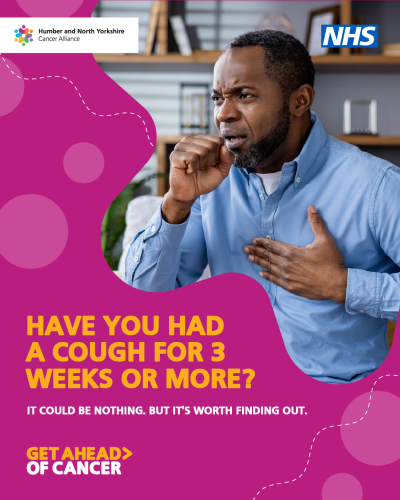
Humber and North Yorkshire Cancer Alliance has launched a campaign to raise awareness of cancer, encourage prevention and increase early diagnosis to help local residents to live longer, healthier lives.
The campaign, ‘Get Ahead of Cancer’, will run until March 2027 and aims to raise awareness of five of the most common cancers: bowel, breast, cervical, lung and prostate.
The first strand of the campaign focuses on signs and symptoms of cancer, what to look out for, recognising changes in your body and contacting your GP to get further support or reassurance.
Diagnosing cancer early and beginning treatment before the cancer grows or spreads can give people a higher chance of a successful recovery.
If you notice any unusual changes to your body, such as blood in your urine or stools, a persistent cough lasting more than three weeks, or unexplained lumps or skin changes, seek advice from your GP.
Don’t think you’re wasting your doctor’s time; they want to see you and investigate your symptoms early. If you do have cancer, identifying it early can give you more treatment options and lead to better outcomes.
Lucy Turner, Managing Director of Humber and North Yorkshire Cancer Alliance, said: “Early diagnosis is one of the most important factors in improving cancer outcomes for local people.
“You can get ahead of cancer by knowing what’s normal for you and getting anything unusual checked. Being aware of the signs and symptoms of cancer means you’re more likely to notice changes and be able to take action early.
“Most changes won’t be cancer, but if they are, finding it early can make a real difference.”
What are some examples of the common signs and symptoms? (This list is not exhaustive)
- Bowel – blood in your poo or changes in bowel habits, constant tummy pain or weight loss
- Breast – new lump, skin changes, swelling or nipple discharge
- Cervical – unusual vaginal bleeding or discharge, pain during sex or pelvic or back pain
- Lung – persistent cough for more than three weeks, breathlessness, wheezing, coughing up blood and recurring chest infections
- Prostate – frequent urination, blood in urine or semen or needing a wee urgently but struggling to get started
Other examples could include unusual tiredness, an unexplained change in weight, a mole that has changed colour, shape or size, or just a feeling that something isn’t quite right.
Denise, from Willerby, said: “I noticed a pain in my right side and thought it was my appendix, so I started driving straight to my GP but the pain was so bad that I went to the hospital instead.
“After some tests, they discovered I had stage 3 lung cancer and they gave me 12 months to live.
“However, following an operation to remove part of my lung and a course of chemotherapy, I am now cancer-free and have been for four years.
“I always act on things when I notice something different with my body because you just never know what it is.
“While I was at the hospital, I saw another patient who had gone through the same thing as me and she was busy recovering from it, so that made me feel better.
“The recovery was hard, but I kept thinking positive thoughts and that helped me get through it.
“Anyone who notices something different about their body should persist and go to get it checked and just get it over with.”
Everyone is different and so the most common signs and symptoms of cancer may not be the same for everyone; it’s important to notice what is unusual for you.
Checking signs and symptoms early with a GP enables you to get clear answers from a professional and stay in control of your body.
Suzanne Bilsdon, from Hessle, said: “I attended a routine mammogram and, despite having no symptoms, I was recalled for further tests.
“This concerned me, but actually it turned out to be an inflammation of my lymph nodes and nothing to worry about.
“I’m glad that it was looked into and it’s so important to have a swift response, because finding out early can really help”.
Figures show that across the Humber and North Yorkshire area almost 12,000 people are diagnosed with cancer each year.
Earlier diagnosis can save lives and improve the quality of life for people living with cancer.
Lung cancer is the leading cause of cancer death in Humber and North Yorkshire, with 1,010 deaths recorded in the last year.
However, 75% of cancers that the Cancer Alliance’s NHS Lung Cancer Screening programme has diagnosed were found at an early stage (stage 1 or 2), and almost 65% of people diagnosed with stage 1 lung cancer survive for five years or more after diagnosis.
By 2035, Humber and North Yorkshire Cancer Alliance aims for three-in-four people diagnosed with cancer to be cancer-free or living well with cancer five years after diagnosis.
The chances of achieving this increase when more people are diagnosed sooner, while their cancer is still at an earlier stage (stage 1 or 2).
GPs are pivotal to this ongoing work as they can spot possible signs of cancers sooner and improve outcomes for patients, getting them the most appropriate tests and referrals as soon as possible.
For this to happen, residents must recognise signs and symptoms that are unusual for them personally and check in with their GP.
For more information, visit https://getaheadofcancer.co.uk/ or talk to your GP if you have any concerns.